What the station does
A close look at three places where millimetres matter: the drum seal, the lid and the tag.
An empty drum stands on four load cells under the filling head. An inflatable seal makes the joint dust-tight and must hold pressure before dosing starts. At the lid station, nitrogen flushes the drum and a ring locks the lid. The tag is then written and read back.
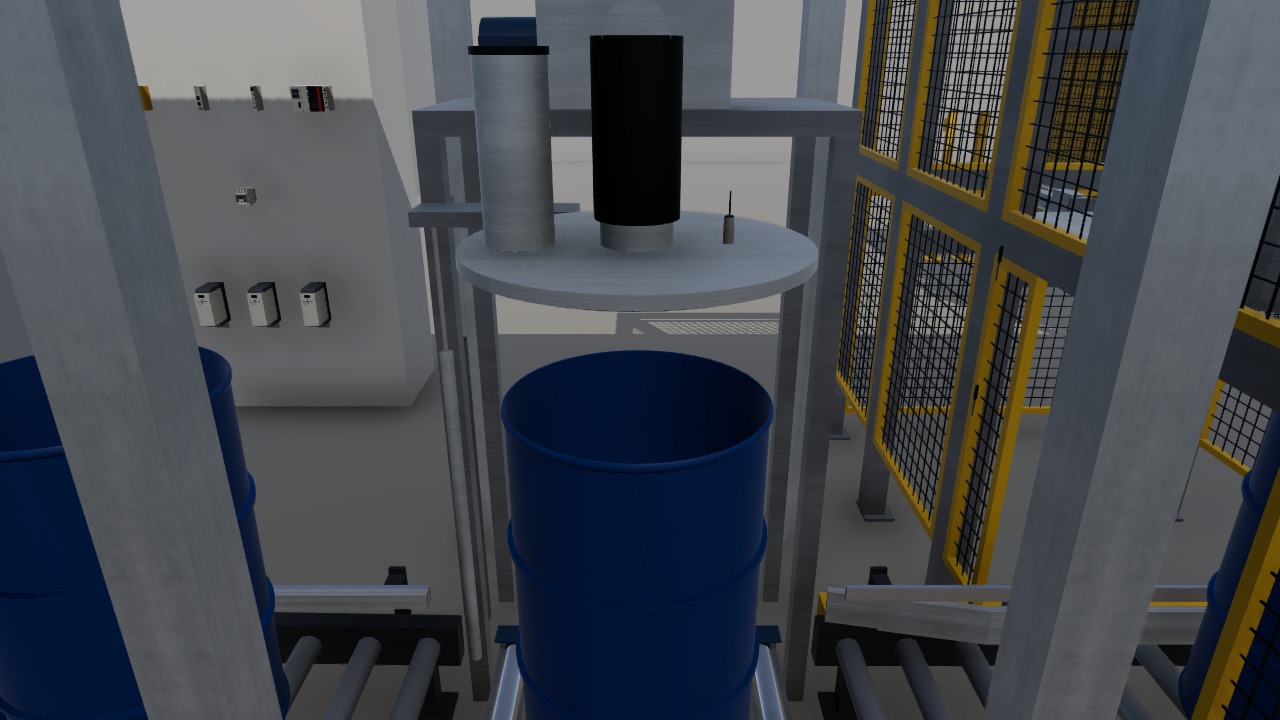
Step by step
- The empty drum must weigh 20 ± 1 kg.
- The seal head lowers onto the rim, and the seal inflates to 5 bar.
- Once the seal holds 4.0 bar, the screw fills fast to 190.0 kg.
- It fills slowly to 200.0 kg and stops early for the powder still falling.
- Nitrogen flushes the drum for 60 s, then the lid is pressed on.
- A cylinder locks the ring, and the tag is written, read back and compared.
Specifications
The devices
Each device is a real catalogue product. Its own product page will follow on the products level.
| Device | Role |
|---|---|
| Dosing screw with speed drive | Doses fast, then slowly at 30 % speed. |
| Four load cells | Weigh the drum, 800 kg range. |
| Inflatable seal with pressure sensor | Makes the drum rim joint dust-tight. |
| Nitrogen pipe and purge valve | Flush the drum with dry nitrogen. |
| Lid head with vacuum cups and ring closer | Set and press the lid, lock the ring. |
| Radio tag reader and lid tag | Store the drum record on the drum. |
Links lead to the makers' public product pages and are given for reference only. This site is independent work, not affiliated with, sponsored or endorsed by any manufacturer. The makers are responsible for the content of their pages. Trademarks belong to their owners.
The signals
| Signal | Direction | Meaning |
|---|---|---|
| Seal pressure | to PLC | Must reach 4.0 bar before dosing. |
| Drum mass | to PLC | Weight for empty drum, dosing and final check. |
| Dosing screw speed | from PLC | Full speed for fast, 30 % for slow. |
| Powder at head | to PLC | Overfill backup: stops the screw at once. |
| Purge pressure | to PLC | 1.0 to 3.0 bar during the purge. |
| Tag read-back | to PLC | Checked against the record before the drum moves. |
About this page
In the scenario, every residue drum from 16 Psyche is sealed, closed and tagged at these three stations.
Real devices, built from real data
Every machine and device in this twin is a real industrial product from the makers' catalogues. They range from sensors, valves and drives to safety scanners, load cells and RFID readers. Each model is built from the product's published data: dimensions, sensing ranges, signals, rated values, parameters and timing.
The PLC programs use the devices' real interfaces and parameters. Before any hardware existed, the twin found hundreds of faults in the plant design and the programs. So a real commissioning would need fine tuning, not a redesign.