Architecture
The control system is built in layers. Each layer has one job and a clear link to the next one. Open a layer to see its points.
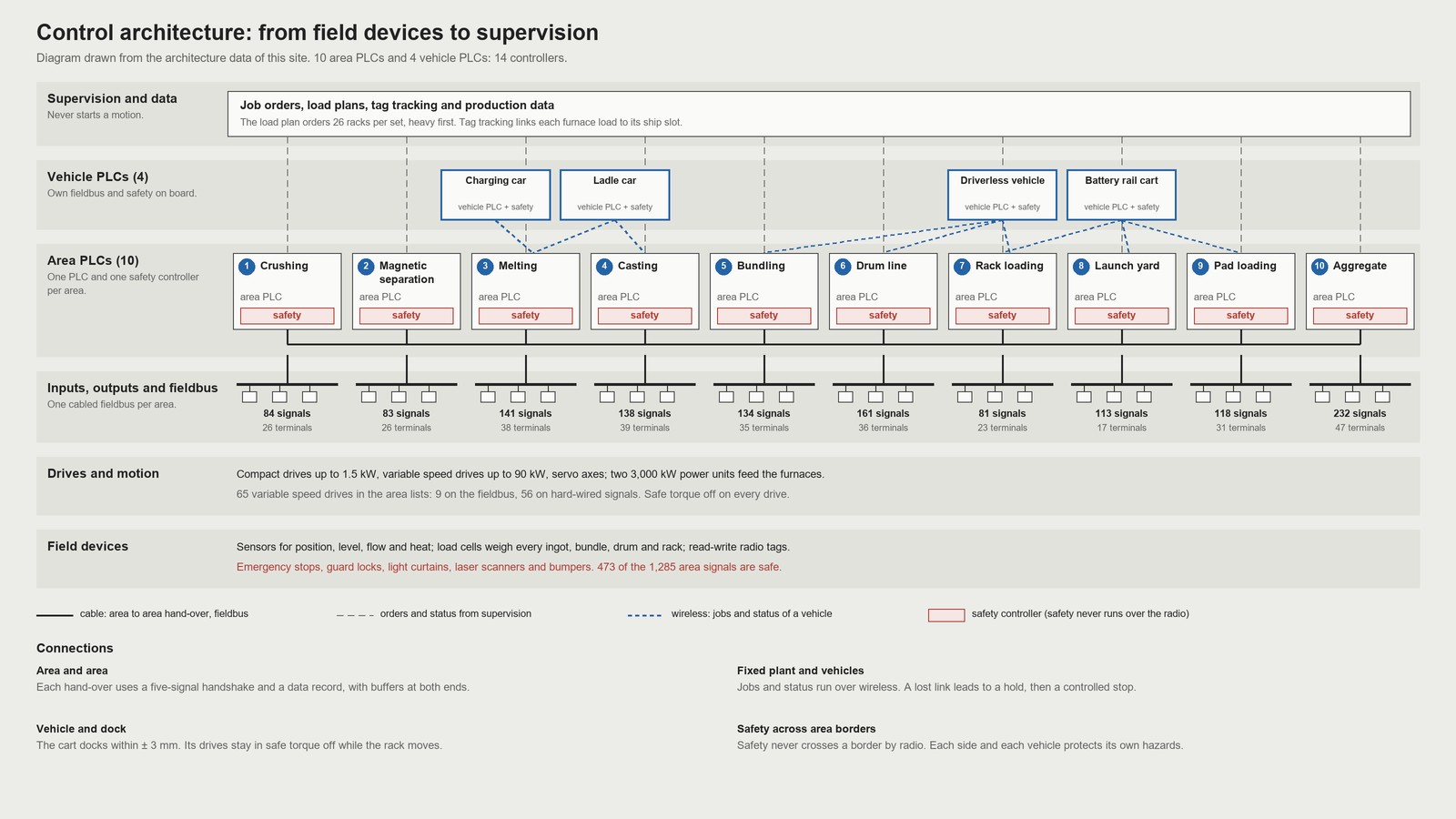
The layers
Field devices
Real catalogue sensors, actuators, weighing and identification devices at every machine.
- Sensors confirm positions and measure levels, flow and heat.
- Load cells weigh every ingot, bundle, drum and rack.
- Read-write radio tags follow every bundle, drum and rack.
Inputs, outputs and fieldbus
Each area and each vehicle has its own fieldbus: a real-time industrial Ethernet network, with cables only.
- Data images come from the vendors' device description files.
- Safety signals share the same fieldbus cable.
- No fieldbus crosses an area border.
- The 10 area I/O lists hold 1,285 signals on 318 terminals in 21 I/O stations. The 4 vehicle lists add 152 signals on 58 terminals.
- Signals per area: crushing 84, magnetic separation 83, melting 141, casting 138, bundling 134, drum line 161, rack loading 81, launch yard 113, pad loading 118, aggregate 232.
- Terminals per area: 26, 26, 38, 39, 35, 36, 23, 17, 31 and 47, in the same order.
PLC control
One PLC (programmable logic controller) per area and per vehicle. Programs use Structured Text, the standard PLC language.
- 10 area PLCs and 4 vehicle PLCs: 14 controllers.
- Every machine follows a standard machine state model.
- Timed step sequences, alarms and one fault test per area.
Safety
A safety controller with safe inputs and outputs in every area and on every vehicle.
- Emergency stops, guard locks, light curtains, laser scanners and bumpers.
- Safe torque off on every drive cuts motor power safely.
- Safety never runs over the radio.
- 473 of the 1,285 area signals are safe: 347 safe inputs and 126 safe outputs.
Drives and motion
Variable speed drives, compact drives and servo axes, each with safe torque off.
- Conveyor motors up to 1.5 kW use compact drives.
- Largest drives: 75 kW and 90 kW on the crushers.
- Two 3,000 kW power units feed the furnaces.
- 65 variable speed drives in the area lists: 9 on the fieldbus, 56 on hard-wired signals.
Vehicles and robots
Four vehicles with their own PLCs, two industrial robots, and the vendor controllers of the large machines.
- Charging car, ladle car, driverless vehicle and battery rail cart.
- Two six-axis robots stack ingot bundles and drum pallets.
- Vendor controllers are black boxes, used through their real signals.
Supervision and data
Job orders, load plans, tracking and production data, above the area PLCs.
- The load plan orders 26 racks per set, heavy first.
- Tag tracking links each furnace load to its ship slot.
- Supervision never starts a motion.
The connections
| Between | How |
|---|---|
| Area and area | Each hand-over uses a five-signal handshake and a data record, with buffers at both ends. |
| Fixed plant and vehicles | Jobs and status run over wireless. A lost link leads to a hold, then a controlled stop. |
| Vehicle and dock | The cart docks within ± 3 mm. Its drives stay in safe torque off while the rack moves. |
| Safety across area borders | Safety never crosses a border by radio. Each side and each vehicle protects its own hazards. |